
Image gallery
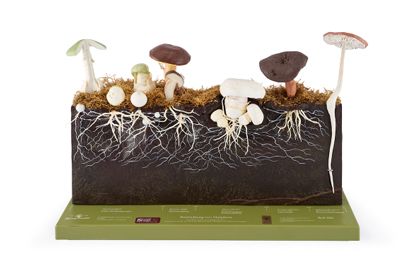
SOMSO® Modelle | Foto: Axel Killian
Development of cap fungi
Made by the company Marcus Sommer SOMSO MODELLE GmbH, the model shows developmental stages of cap fungi to scale. It shows the mycelium, primordial and egg stages, young and mature fruiting bodies of the following fungal species:
The actual organism of fungi is the fungal mycelium. It consists of thin, barely visible threads (hyphae) in the host substrate, i.e. soil, wood, leaves, etc., depending on the species of fungus. For reproduction, small, spherical interweavings of the fungal mycelium form, from which the fruiting bodies (spore carriers) emerge. These are called primordia. The young cap fungus matures from these in the substrate and can then develop on the surface through massive water absorption.
Some fungi, such as the death cap and the mushroom, have a special protective cover (veil) that protects the fruiting layer (hymenium) of the cap fungus. If the mushroom stipe rises up from the ground, the velum of the porcelain fungus dissolves into slime. The stipe of the porcelain fungus is embedded in the soil, this part is called a rhizoid (pseudorhiza).
In the case of the death cap fungus, the veil remains closed for a longer period of time, resulting in a structure that looks like an egg. This is why these mushrooms are also referred to as the egg stage. When the mushroom stretches, a tuber (volva) remains at the base of the stem. The "leaves" are the lamellae of the cap fungus.
In the case of the mushroom, the veil connects the edge of the cap to the stem. When the cap unfolds, the velum tears off at the edge of the cap and remains as a ring on the stem. It can be pulled off downwards.
Source: Dörfelt, Heinrich und Erika Ruske. Morphologie der Großpilze. Springer-Verlag Berlin, 2014.
1. Death Cap (Amanita phalloides).
2. Bay Bolete (Xerocomus badius)
3. Pavement Mushroom (Agaricus bitorquis)
4. Shingled Hedgehog (Sarcodon imbricatus)
5. Deep Root or Rooting Shank Mushroom (Oudemansiella radicata)
The actual organism of fungi is the fungal mycelium. It consists of thin, barely visible threads (hyphae) in the host substrate, i.e. soil, wood, leaves, etc., depending on the species of fungus. For reproduction, small, spherical interweavings of the fungal mycelium form, from which the fruiting bodies (spore carriers) emerge. These are called primordia. The young cap fungus matures from these in the substrate and can then develop on the surface through massive water absorption.
Some fungi, such as the death cap and the mushroom, have a special protective cover (veil) that protects the fruiting layer (hymenium) of the cap fungus. If the mushroom stipe rises up from the ground, the velum of the porcelain fungus dissolves into slime. The stipe of the porcelain fungus is embedded in the soil, this part is called a rhizoid (pseudorhiza).
In the case of the death cap fungus, the veil remains closed for a longer period of time, resulting in a structure that looks like an egg. This is why these mushrooms are also referred to as the egg stage. When the mushroom stretches, a tuber (volva) remains at the base of the stem. The "leaves" are the lamellae of the cap fungus.
In the case of the mushroom, the veil connects the edge of the cap to the stem. When the cap unfolds, the velum tears off at the edge of the cap and remains as a ring on the stem. It can be pulled off downwards.
Source: Dörfelt, Heinrich und Erika Ruske. Morphologie der Großpilze. Springer-Verlag Berlin, 2014.
References
- Dörfelt, Heinrich; Ruske, Erika: Morphologie der Großpilze. mit 112 Farbbildtafeln, Glossar und Namensregister. Berlin, Heidelberg; Berlin, Heidelberg 2014.